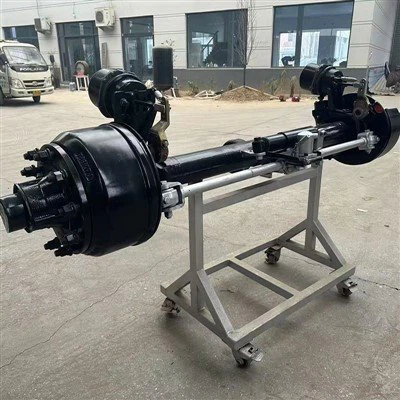
Based on their structural form, drive axles can be divided into three main categories:
Central Single-Stage Reduction Drive Axle
This is the simplest type of drive axle structure and the basic form, dominating in heavy-duty trucks. Generally, when the main transmission ratio is less than 6, a central single-stage reduction drive axle should be used. The central single-stage reducer tends to use hypoid spiral bevel gears, the driving pinion uses a saddle-mounted support, and a differential lock is available as an option.
Central Dual-Stage Reduction Drive Axle
In the domestic market, there are two main types of central dual-stage drive axles: One type is a heavy-duty truck rear axle design, such as Eaton series products. Space is pre-reserved in the single-stage reducer. When increased traction and speed ratio are required, a cylindrical planetary gear reduction mechanism can be installed, transforming the original single-stage central axle into a central dual-stage drive axle. This modification has a high degree of "three-fold standardization" (i.e., serialization, generalization, and standardization), with interchangeable axle housings, main reducers, etc., and the bevel gear diameter remaining unchanged. The other type, such as Rockwell series products, requires modification of the first-stage bevel gear before installing a second-stage cylindrical spur gear or helical gear to achieve the required central dual-stage drive axle when increased traction and speed ratio are needed. In this case, the axle housing is interchangeable, but the main reducer is not, and the bevel gears have two specifications. Because the aforementioned central double-stage reduction axles are all models derived from a series of products when the speed ratio of the central single-stage axle exceeds a certain value or the total traction mass is large, they are difficult to modify into front drive axles, thus limiting their use. Therefore, generally speaking, double-stage reduction axles are not developed as a basic type of drive axle, but rather exist as drive axles derived for specific considerations.
Central Single-Stage, Wheel-End Reduction Drive Axle
Wheel-end reduction drive axles are widely used in off-highway vehicles and military vehicles in oil fields, construction sites, mines, etc. Currently, wheel-end reduction axles can be divided into two categories: one is the bevel planetary gear type wheel-end reduction axle; the other is the cylindrical planetary gear type wheel-end reduction drive axle. The bevel planetary gear type wheel-end reduction axle consists of a wheel-end reducer composed of bevel planetary gear transmissions, with a fixed wheel-end reduction ratio of 2. It is generally combined with a central single-stage axle to form a series. In this series, the central single-stage axle retains its independence and can be used alone. When it's necessary to increase the axle's output torque, thereby increasing traction or the speed ratio, a double-stage axle can be created by adding bevel planetary gear reducers to the two axle ends without changing the central final drive. The difference between this type of axle and the central double-stage reduction axle lies in reducing the torque transmitted through the half-shafts and directly increasing the torque to the wheel-side reducers at both axle ends, resulting in a higher degree of integration. However, because the wheel-side reduction ratio is a fixed value of 2, the size of the central final drive is still relatively large, and it is generally used in highway and off-road military vehicles. Cylindrical planetary gear wheel-side reduction axles, including single-row, fixed-ring cylindrical planetary gear reduction axles, typically have reduction ratios between 3 and 4.2. Due to the large wheel-side reduction ratio, the speed ratio of the central final drive is generally less than 3, allowing for a smaller diameter for the large bevel gears to meet the ground clearance requirements of heavy-duty trucks. These types of axles are heavier and more expensive than single-stage reduction gears. Moreover, they have gear transmissions within the wheel wells, which can generate a lot of heat and cause overheating when driven on highways for extended periods. Therefore, as a drive axle for highway vehicles, they are not as good as central single-stage reduction axles.