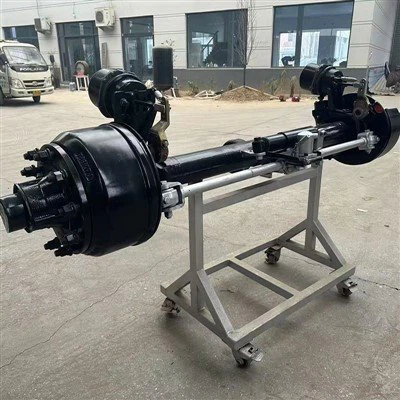
The drive axle, located at the end of the powertrain, has the following basic functions:
① Transmits the engine torque from the universal joint drive to the drive wheels via the final drive, differential, and half-shafts, achieving speed reduction and torque increase;
② Changes the direction of torque transmission through the bevel gear pair in the final drive;
③ Enables differential speed control between the inner and outer wheels through the differential, ensuring they steer at different speeds;
④ Provides load-bearing and torque transmission through the axle housing and wheels.
The drive axle is a mechanism located at the end of the transmission system that changes the speed and torque from the transmission and transmits them to the drive wheels. A drive axle generally consists of a final drive, differential, wheel drive mechanism, and drive axle housing. Steering drive axles also include constant velocity joints. In addition, the drive axle must withstand vertical, longitudinal, and lateral forces acting between the road surface and the vehicle frame or body, as well as braking torque and reaction forces.