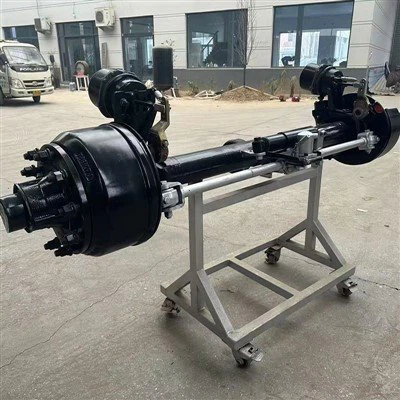
The trailer axle is the core load-bearing and safety component of semi-trailer chassis. Its durability, machining accuracy and heat treatment quality directly determine vehicle safety, tire wear, braking stability and overall service life. Many fleet failures, downtime losses and after-sales complaints stem from improper procurement judgments rather than daily usage problems. This article summarizes the most common trailer axle procurement mistakes and provides practical quality identification methods for global buyers, trailer manufacturers and spare parts distributors.
1. Common Procurement Mistakes
1.1 Only Referring to Rated Tonnage, Ignoring Actual Working Conditions
Trailer axles with the same tonnage label are not identical. Standard-duty and heavy-duty reinforced axles have huge differences in axle tube thickness, ductile iron grade, journal hardening depth and structural fatigue resistance.
Buyers who choose axles simply based on rated tonnage often face safety risks under harsh working conditions such as mining roads, construction sites and frequent bumpy routes. Standard axles cannot withstand long-term impact overload, which easily causes axle tube bending, fatigue cracking and wheel end failure.
1.2 Excessively Pursuing Low Prices and Ignoring Hidden Process Defects
Most core axle quality processes are invisible from the outside, including induction hardening, welding flaw detection, dynamic balance testing, material composition and heat treatment.
Low-cost axles usually reduce production costs by thinning axle tubes, downgrading casting materials, shortening heat treatment procedures and canceling nondestructive testing. Although the appearance looks the same, these unqualified processes will lead to bearing burnout, hub cracking, brake failure and axle breakage after long-distance heavy transportation. The later maintenance and downtime losses far exceed the initial procurement price difference.
1.3 Confusing Original Assemblies, OEM Parts and Counterfeit Axles
Many counterfeit trailer axles imitate mainstream brand appearances, but they lack precise control of machining tolerance, bearing seat accuracy, oil seal matching size and welding consistency.
After installation, counterfeit axles frequently cause abnormal wheel end heat, wavy tire wear, oil seal leakage and unstable braking. For bulk export procurement, relying only on appearance judgment is extremely risky. Professional buyers always require material certificates and factory test reports for verification.
1.4 Ignoring Non-Interchangeable Risks Between Different Axle Systems
American-style (FUWA type) and German-style (BPW/SAF type) trailer axles belong to completely different technical systems. Their bearings, oil seals, brake drums, slack adjusters and hub bolts are not universal and cannot be interchanged.
Mixing different axle systems in export orders will cause great trouble for overseas after-sales maintenance. Local customers cannot find matching spare parts, resulting in long-term vehicle downtime and serious customer complaints.
1.5 Focusing Only on Axle Price, Ignoring Aftermarket Parts Availability
Some customized niche axles are cheap, but their supporting spare parts have very low market circulation. Once damaged in remote areas or overseas markets, the replacement cycle is extremely long, causing huge economic losses for logistics fleets.
For export business, it is safer to choose mature and mainstream axle structures with complete global spare parts supply chains.
1.6 Only Valuing the Axle Body, Neglecting Supporting Component Quality
Most wheel end failures are not caused by axle tube damage, but by inferior supporting parts such as bearings, oil seals and brake drums. Poor-quality accessories lead to oil leakage, high temperature, abnormal noise and shortened overall axle service life. Reliable axle manufacturers always adopt qualified brand accessories for complete assembly matching.
2. Professional Axle Quality Identification Points
2.1 Visual Appearance Inspection
Axle Tube and Welds High-quality axles have smooth and flat axle tube surfaces. The welding lines are full, uniform and dense without pores, slag inclusions, virtual welding or cracks. The journal machining surface is smooth without obvious tool marks, burrs or impact dents.
Wheel Hub Casting Qualified ductile iron hubs have compact texture, few sand holes and no shrinkage cavities. The stud holes and assembly surfaces are precisely machined. Hubs with dense sand holes and rough casting surfaces are prone to cracking under heavy load.
Brake Drum The inner friction surface is evenly processed with no obvious casting defects. Standard weight and stable thickness ensure good heat dissipation and thermal crack resistance during continuous braking.
2.2 Document and Certification Verification
Professional export manufacturers can provide complete factory documents:
Raw material quality certificates for axle tube and hub ductile iron
Weld nondestructive testing (NDT) reports
Dynamic balance test records and bearing clearance inspection reports
ECE R13 certification for European market and DOT compliance documents for North America
2.3 Simple On-Site Inspection Methods
Rotate the hub smoothly without jamming, stagnation or abnormal shaking. Excessive play indicates unqualified bearing assembly clearance.
Check key dimensions including flange size, brake drum register and bolt hole spacing to ensure perfect matching with customer suspension and brake systems.
3. Scientific Procurement Suggestions for Global Buyers
Sample Confirmation First Before bulk orders, confirm sample appearance, dimensional accuracy and assembly performance. Conduct bench fatigue tests if conditions permit.
Clear Technical Agreements Clearly specify axle tube wall thickness, ductile iron grade, induction hardening requirements and testing standards in the contract to avoid cutting corners.
Complete Spare Parts List for Export Provide customers with complete wearing part models, including bearings, oil seals and brake drums, to support local after-sales replacement and maintenance.
Conclusion
Trailer axle procurement is not simply price comparison. Working condition matching, material quality, manufacturing process and aftermarket support determine the long-term operational safety of semi-trailers. Avoiding common procurement mistakes and mastering professional quality identification methods can help global trailer manufacturers and fleet buyers select cost-effective, high-reliability heavy-duty trailer axles and reduce overall operating costs.
Reference Sources
This article's technical standards, quality inspection criteria and industry conclusions are based on authoritative industry specifications and professional research reports, ensuring professionalism, accuracy and industry compliance:
JT/T 475-2020: Official industrial standard for trailer axle technical requirements and test methods, Ministry of Transport of China
ECE R13 & DOT FMVSS: International authoritative safety certification standards for trailer braking and axle systems
CAAM Industry Report: Professional commercial vehicle parts quality and market evaluation guidelines from China Association of Automobile Manufacturers